
Beyond Compliance: What Billington Reinforced About Federal Cybersecurity
 by: Michael Cardaci
October 2, 2026
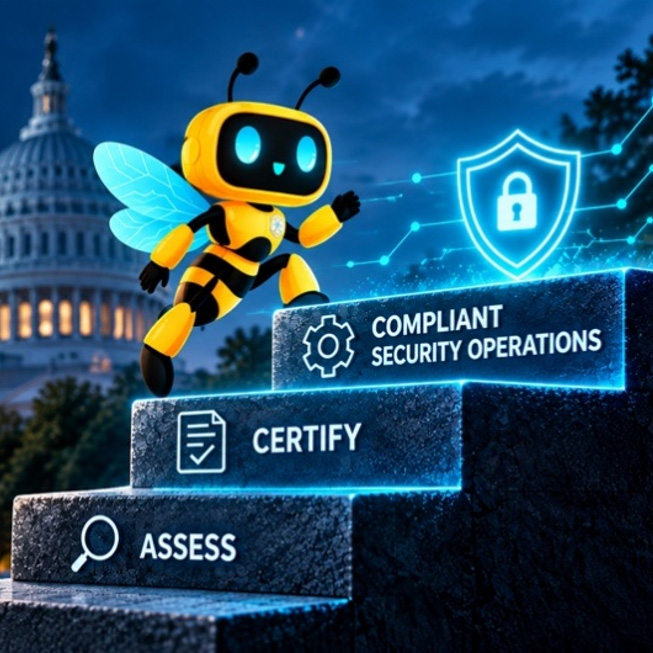
I left this year’s Billington CyberSecurity Summit with one message reinforced again and again: cybersecurity can’t be treated as a milestone. It has to be an operating model.
That idea isn’t new to us at FedHIVE. It has long shaped how we approach federal cloud security. Authorization matters, but getting across the compliance finish line is only part of the job. The real test is whether an environment remains secure, compliant, and ready to support the mission as technology and threats evolve.
Across three days at Billington, we heard that same philosophy echoed by FedCiv, military and industry leaders. We know that AI is accelerating innovation—and the threats that come with it. Longstanding vulnerabilities are becoming harder to ignore. And the old model of periodically checking whether an organization is secure simply doesn’t work anymore.
The question is no longer just, "Are we compliant?" It’s "Are we operating securely every day?"
Compliance Is Just the Starting Point
Frameworks such as FedRAMP and CMMC are essential to establishing security requirements and building trust in the technology government uses. But compliance represents a moment in time. Security exists in an environment that never stops changing.
Software gets updated. Configurations shift. New vulnerabilities emerge. And AI is accelerating the speed at which adversaries can find and exploit weaknesses. That is why FedHIVE has long approached compliance as part of a broader model of compliant security operations.
Federal cyber leaders at Billington repeatedly returned to the fundamentals: knowing what is in your environment, managing who has access to it, finding vulnerabilities and fixing them quickly. The concepts aren't new, but the urgency is. One of the strongest examples came from Lt. Gen. Paul Stanton, who argued that defense networks should be treated with the same readiness mindset applied to weapon systems.
It's a useful comparison. We wouldn't certify an aircraft as operational once and assume it will remain mission-ready indefinitely. It is maintained, tested, and evaluated throughout its lifecycle. Our digital infrastructure deserves the same discipline. Security shouldn't be something an organization prepares for when an assessment approaches. It should be part of how the environment operates every day.
Building a Better Bridge Between Government and Technology
Billington also reinforced something we see every day in our work with government and technology companies: better cybersecurity requires better partnerships. Some of the world's most innovative technology is being developed in the commercial market. But a great commercial product doesn't automatically become a great government solution.
Technology providers entering the federal market have to navigate security requirements and authorization processes that may be entirely new to them. Government customers, meanwhile, want access to innovation without adding unnecessary risk or operational complexity.
There needs to be a bridge between those worlds. That's where accelerator partners like FedHIVE have an important role to play. We don't see our job as simply helping a company get through FedRAMP. We help technology providers understand what it takes to operate successfully in government environments, build the infrastructure to support those requirements, and maintain secure operations over time.
At the same time, we help government customers gain confidence that the technologies they adopt can meet security requirements—without losing sight of why they purchased the technology in the first place: to accomplish the mission.
That requires understanding both sides of the equation. Technology companies need room to innovate and scale. Government organizations need security, resilience and accountability. The accelerator sits between them, helping find the mission-based balance of security, performance and cost that makes both possible.
The Path Forward
Billington was a strong reminder that the next phase of federal cybersecurity won’t be defined by a single framework, technology or authorization. It will be defined by how well government and industry work together to make security part of everyday operations.
That’s the opportunity ahead: to make it easier for government to adopt innovation without compromising trust—and for technology companies to enter the federal market ready to support the mission from day one.